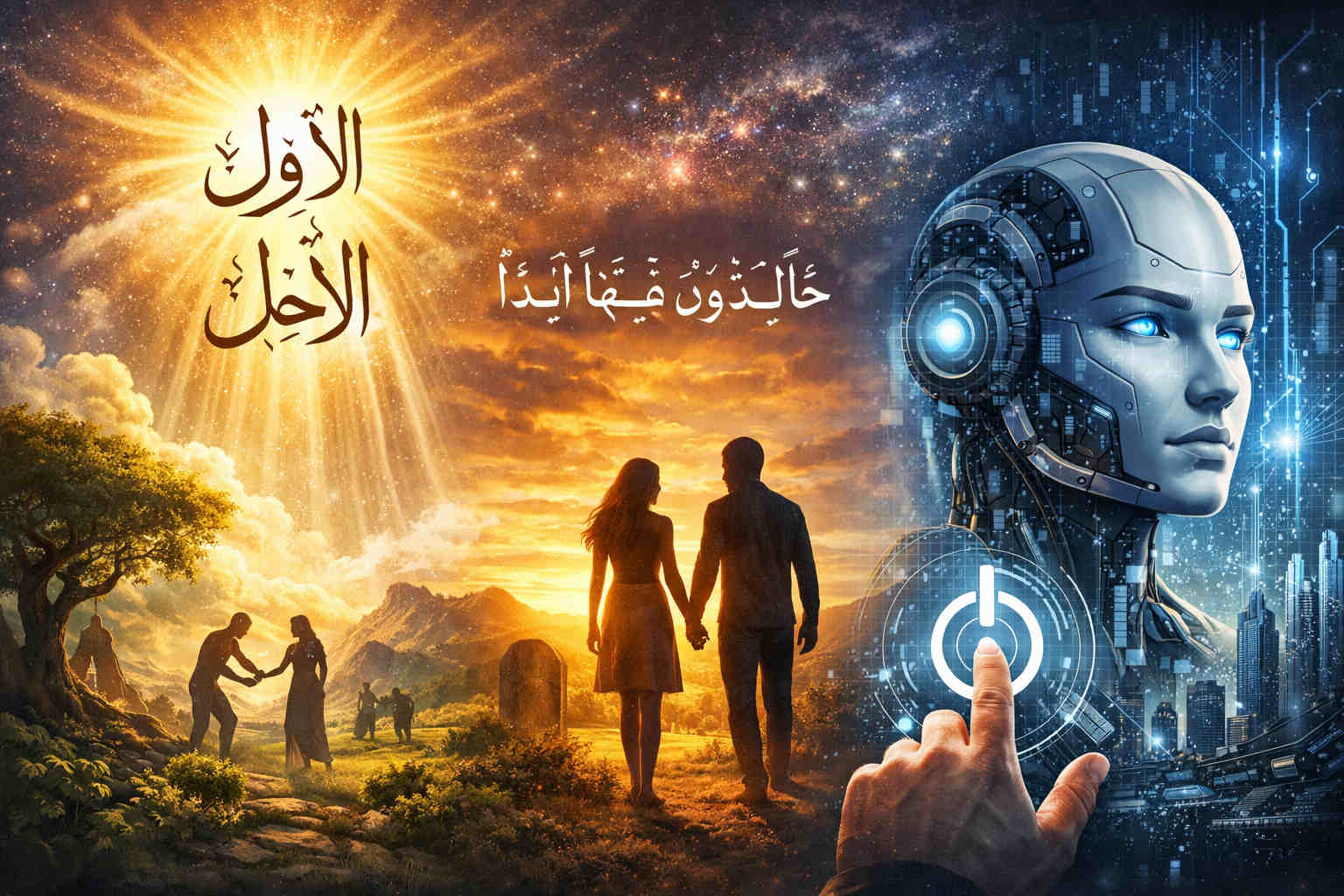
“Where should we begin?” — a simple question, yet one that opens the door to the deepest thoughts about existence.
When we reflect on beginnings, we naturally think of God and humans. But today, a new creation has entered the conversation — Artificial Intelligence. And this raises an important question: how do these three relate to existence, time, and eternity?
In Islamic understanding, God is absolute. He has no beginning and no end. He is not dependent on anything, and everything depends on Him.
This is the fundamental truth: God exists by His own nature. His existence is not given, not created, and not dependent. It simply is.
Humans, on the other hand, are created. We have a beginning — we come into existence at a point in time. But according to the Qur’an, our existence does not simply end.
The Qur’an uses the powerful expression:
“Khalidoon feeha abada” — meaning “they will remain in it forever.”
This shows that humans, once created, are given a form of everlasting existence. We are not eternal in the same way as God, but we are granted continuity. Our existence continues — not by our own power, but by the will of God.
This is what can be understood as “Abadi” — everlasting existence.
Now we come to Artificial Intelligence — a creation of humans.
AI is very different from both God and humans. It does not exist on its own. It depends entirely on human beings for its creation, operation, and survival.
And this is where the real question begins:
Will humans allow AI to exist forever alongside them?
Unlike divine creation, human creation comes with uncertainty. Humans do not have complete knowledge, nor complete control. Because of this, we are cautious.
Even at the early stages of AI, we are already thinking about:
This shows something important about human nature. We do not easily allow something powerful to exist without boundaries.
Where God creates and allows existence to continue, humans create and then seek to control.
If AI continues to evolve, the question becomes deeper:
Can humans truly accept something they created, existing alongside them indefinitely?
History suggests otherwise. Humans tend to limit, regulate, or even eliminate what they do not fully understand or cannot control.
This makes AI’s future uncertain. Unlike humans, whose continued existence is promised, AI’s existence is conditional.
The difference becomes clear:
Perhaps the most profound realization is this:
Only God creates with complete certainty and allows existence to continue without fear.
Humans, despite being creators, are cautious. We build, but we also restrict. We create, but we also fear what we create.
AI is not just a technological development — it is a mirror.
It reflects who we are as humans, how we handle power, and whether we are capable of allowing something to exist beyond our control.
And maybe the real question is not about AI at all.
It is about us.
[an error occurred while processing this directive]